

Humanizing Special Ed

Individualized Education Program (IEP)
Jargon on Scrabble Board

Image source: cft.vanderbilt.edu

It’s easy for parents and educators alike to get lost in the Individualized Education Program (IEP) process and the numerous Individuals with Disabilities Education Act (IDEA) regulations. In an IEP meeting stuffed full of lawyers, speech therapists, occupational therapists, educators, and administrators, where exactly does your child fit in? Sure, the entire meeting is about his speech disorder and particular needs, but in a sea of acronyms (ESY, FAPE, S/LI, and TSS, to name just a few) it can be easy for the IEP team to forget that there is an actual child at the heart of all that jargon. No one knows your child and his speech therapy needs better than you and your partner. You’ve looked after his health from conception onward and made sure he had everything from healthy foods to speech therapy tools. So when it’s time to advocate for him in an IEP meeting and elsewhere at school, make sure that the people who are discussing his education actually know who he is.

Continue reading

Transition Services

Individualized Education Program (IEP)
Success Next Exit Sign

Image source: mtdeafblind.ruralinstitute.umt.edu

When your child has an Individualized Education Program (IEP), he has a support structure within the school. He likely has speech therapy sessions with the school speech-language pathologist (SLP), he may have a one-on-one aide in the classroom, and he may have other accommodations as well. But what happens when he leaves school? As your child grows into a young adult and nears graduation age, you may start to worry about how he’ll handle the outside world with a speech disorder. The Individuals with Disabilities Education Act (IDEA) provides for transition services, which are intended to facilitate independent living and post-secondary education, if applicable.

Continue reading

Using Augmentative and Alternative Communication (AAC) Devices

Speech Therapy Techniques
Children Using AAC Devices

Image source: CLASS, Inc.

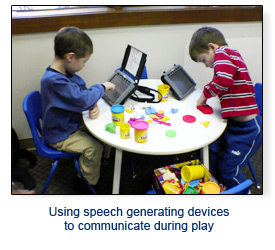
Speech disorders can range from problems with articulation to problems speaking any words at all, such as selective mutism. Children who cannot speak at all or those who speak very little have difficulty expressing their basic needs and wants. This can become frustrating for them, which may sometimes result in behavioral issues. One solution is providing your child with an alternative means of communication.

Continue reading

How to Teach the “P” Sound

Speech Therapy Techniques
Speech Therapist Working with Child

Image source: icanteachmychild.com

Your child’s speech-language pathologist (SLP) should provide you with activities to do at home to encourage your child’s progress. If not, ask the SLP for “homework.” If your child needs help with individual sounds, work on helping him master those sounds before moving on to syllables and whole words.

Continue reading

Dispelling Speech and Language Therapy Myths

Language Development Speech Disorders
Baby Talking on Headset

Image source: accuracy2010.org

When you first begin to research speech therapy and speech disorders, chances are you will come across some misguided information. You might hear that your child will likely grow out of his speech disorder, that you should never use “baby talk” with an infant, or that living in a bilingual household is detrimental to your child’s language development. When in doubt, never hesitate to ask your child’s speech therapist about these issues.

Continue reading