Best Back-to-School Homework Help Apps

School
Kitten Using App

Image source: Apartmenttherapy.com

Many children have speech and language issues as a symptom of another condition, such a traumatic brain injury (TBI) or autism. Conditions and disorders such as these often cause other barriers to academic success as well, such as problems with time management, organization, and problem-solving. Some children with a TBI may have difficulty starting a task, for example. Barriers such as these may be difficult to cope with, but equipping your child with the right back-to-school tools can help him reach his academic goals. Your child’s back-to-school tools might include Speech Buddies for articulation or a shiny new iPhone with homework help apps. Many homework help apps assist your child with time management skills and assignment tracking. On the list below, there is also an app that can even encourage vocalization. Standard note-taking apps can also improve writing skills. Many of these apps are designed for older children or high school kids.

Continue reading

Breakthrough Research in Early Autism Detection

News
Autism Awareness Benefit Walk

Image source: Suite101.com

About one in every 150 American children is diagnosed with autism, according to WebMD. Chances are, you know someone who has an autism spectrum disorder (ASD) or someone who is affected by it. Autism awareness grows every year, with advocacy groups and benefit walks springing up regularly across the nation. But we still don’t really understand a whole lot about it. We don’t know the cause, although numerous factors are suspected to contribute to it. And there is no cure for it, either.

Autism can result in many different symptoms – from behavioral problems to sensory defensiveness to social difficulties. Children with ASD also tend to display speech and language issues. Some of them are nonverbal and prefer to communicate with gestures. Although there is no cure for autism, researchers do know that early intervention is critical. Children who receive speech therapy and other treatments tend to respond better when the treatment begins as early as possible. Unfortunately, most cases of autism aren’t diagnosed until symptoms are evident around the time the child is 2-3 years old. This is why the research from Georgia Tech’s Center for Behavior Imaging is so exciting. Researchers have been working on technologies that would allow for earlier detection of ASD, and subsequently, earlier treatment.

Tracking Eye Movement

Children with ASD typically display a reluctance to make or maintain eye contact with other people. Previously, researchers had the labor-intensive task of sorting through countless video frames to measure the eye contact of an autistic child. The researchers at Georgia Tech have developed a special pair of eyeglasses that can do the same thing automatically.

The eyeglasses are worn by an adult, who then interacts with the child. The eyeglasses are equipped with a front-facing camera that records video. The video is then analyzed by facial-recognition software that detects the direction of the child’s gaze. An experiment with the glasses demonstrated an accuracy of 80%.

Accelerometers for Behavior Detection

The researchers at Georgia Tech also developed technology to track behavioral patterns that can be indicative of autism. This technology is a wearable device that uses accelerometers to track and categorize behaviors. The sensors are worn on the wrists and ankles in order to measure movement. For example, the device tracks when a child throws an object.

Boy with Autism

Image source: Longevitycentres.com

Four staff members tested the device by performing 1,200 different behaviors (presumably, that included throwing things around). Not only did the staff members have a really interesting day at work, they were able to determine that the device detected problem behaviors with 95% accuracy and classified all behaviors with 80% accuracy. The researchers then placed the device on a child diagnosed with ASD. Problem behaviors were detected with 81% accuracy and classified with 70% accuracy.

So what does all that research mean for your child? The technology is still new; don’t expect it in your local clinic any time soon. But it is certainly promising that autism diagnostics are going high-tech. The earlier a child can get help, the more effective the treatment is likely to be. This holds true for other speech disorders, as well. If your child has problems with articulation or other communication issues, have him evaluated by a speech-language pathologist. If he does need help, the SLP can also recommend speech therapy activities to do at home with your child, such as using Speech Buddies to improve articulation.


Parent's Guide to Speech & Communication Challenges

Development Chart: Speech and Language from 3rd – 5th Grade

Language Development
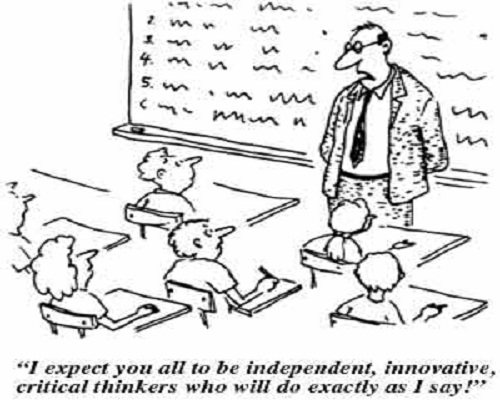
School Humor Cartoon

Image source: Leadinginthemargins.com

As a parent, it’s all too easy to catch yourself comparing your child to other children. “My daughter is much more mature than her friends… If only my son were more interested in sports…” And if your kidling is younger, you’ll likely compare him to charts. You’ll compare his height to growth charts and his cognitive abilities to a development chart. A development chart can be useful for tracking your child’s speech and language development.

However, it’s important to avoid overreacting if your child appears to be lagging a bit behind for his peer group. Every child is unique. Being a little behind the targets on the development chart does not automatically mean that your child has a speech disorder or delay. However, it’s always best to schedule an evaluation by a speech-language pathologist (SLP) to be on the safe side. If your child does need a little extra help, he’ll benefit the most from speech therapy earlier rather than later. There are many speech therapy techniques that can help your child, such as Speech Buddies for articulation practice.

Continue reading

Development Chart: What Your Child Should Know

Language Development
Child Measuring Height - Norman Rockwell

Image source: Southernbellesimple.com

Parents of young children are often surrounded by charts. Growth charts that measure height, developmental milestone charts, child speech development charts, and charts full of advice on feeding your family healthy foods. Sometimes it’s a little overwhelming. What if your child isn’t reaching his milestones? Does this automatically mean there is a problem?

Not at all. Avoid hitting the panic button. Remind yourself that every child progresses at his own rate. However, it never hurts to have him evaluated by a speech-language pathologist (SLP) just in case he might have a speech disorder or delay. It’s a good idea to periodically evaluate your child’s progress with the help of a development chart. You can also ask your child’s teacher for observations about his speech and language development, as well as his progress in other critical areas, such as social development.

Continue reading

An IEP Review for Special Education

Individualized Education Program (IEP)
IEP Humor Cartoon

Image source: Familyenjoyinghi5autism.blogspot.com

If your child qualifies for free help in the special education program under the Individuals with Disabilities Education Act (IDEA), he will have an Individualized Education Program (IEP). This written document spells out the specific services to which he is entitled in school. The IEP team is required to review the IEP annually to determine if it still suits his needs. If it does not, the document will be modified. However, if you believe that your child’s IEP no longer suits his needs prior to the annual meeting, you can request an IEP meeting at any time. It’s a good idea to periodically look over the IEP to refresh your memory and decide if a change is in order. Mark your calendar every few months to remind you to review the IEP. The back-to-school season is one good time to do it.

Continue reading