

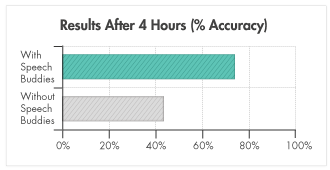
The INTACT study was a randomized, controlled single blind study and it showed that children age 5-8 learn nearly twice as fast using Speech Buddies as compared to children just using traditional methods of teaching. [3]
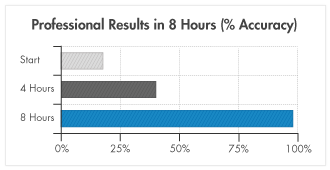
This study demonstrates the effectiveness of trained parents in administering speech remediation using Speech Buddies. Results show remediation after only 8 hours, far below the industry standards. [6]
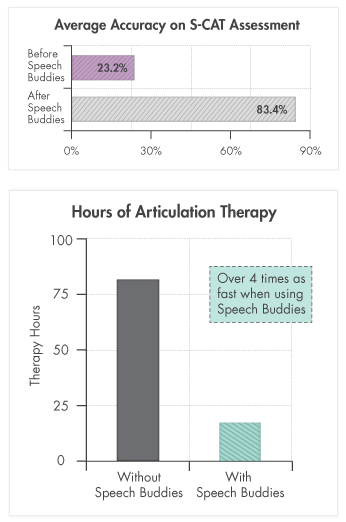
This study demonstrates the effectiveness of an organic integration of Speech Buddies into a typical school speech therapy setting at five schools. Substantial improvement of articulation was achieved in nearly 1/5 the number of therapy hours and at nearly 1/4 the cost of prior therapy.[4]
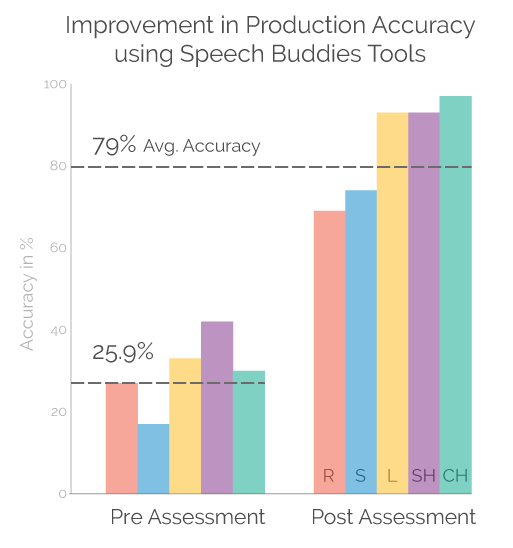
Justina Heintz, MS, CCC-SLP, working on behalf of her school district, conducted this study to test Speech Buddies Tools as a cost-effective methodology in tactile biofeedback. She found strong evidence that using Speech Buddies as an intervention method improves marks.[9]
"He has been working on /r/ over 3 years, he is now producing /r/ with 80% accuracy."
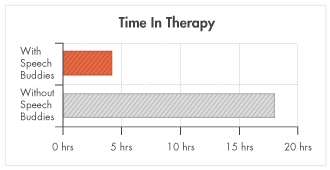
This study shows how Speech Buddies used to treat the R sound can generate outcomes that are more than four times faster than the best industry standards.[2]
Speech-Language Pathology & Audiology Professor, West Virginia University
Director, Open Lines Speech and Communication
Director, Full Potential Resource Center
[1] “Examining the Clinical Application of Intra-Oral Tactile Biofeedback in Short-Duration Therapy ”, Gordy Rogers and Megan Chesin, Pennsylvania Journal of Speech Language and Audiology (2014)
[2] “Hand-Held Tactile Biofeedback as a Cuing Mechanism to Elicit and Generalize Correct /R/”, Gordy Rogers, Ohio Journal of Speech Language and Audiology (2014): 39-55
[3] Evaluating the Efficacy of Treating Misarticulated /s/ with Tactile Biofeedback - San Diego, American Speech and Hearing Association, 2011, Gordy Rogers and Jessica Galgano.
[4] Examining the Effectiveness of Tactile Biofeedback in Charter Schools- Atlanta, American Speech and Hearing Association, 2012, Gordy Rogers, Julia Lee, Elise Parmentier.
[5] Treating Misarticulated /r/ with Speech Buddies, Philadelphia, American Speech and Hearing Association, 2010, Gordy Rogers.
[6] Parent Effectiveness in Treating Speech Sound Disorders Through Tactile Biofeedback - San Diego, American Speech and Hearing Association, 2011, Gordy Rogers.
[7] Phonemic and Tactile Cueing for Remediation of American English /r/ - Chicago, American Speech and Hearing Association, 2013, Nanette Cote
[8] Using Tactile Biofeedback, In The Form of Speech Buddies, For Treatment of Therapy Resistant Students Who Misarticulate /r/. San Francisco, California Speech and Hearing Association, 2014, Jennifer Rasore
[9] Buddy Feedback - San Antonio, Texas Speech-Language-Hearing Association, 2015, Justina Heintz, MS CCC-SLP
[10] Gordy Rogers, MS, CCC-SLP Chicago, American Speech and Hearing Association, 2013: Evidence-Based Application of Device Technology in Speech Sound Disorders: A Clinical Workshop
[11] Speech Buddies and Intra-Oral Tactile Biofeedback: An Efficacy Study - Review of a single blind, randomized controlled trial. Gordy Rogers, Jessica Galgano
[12] Effectiveness of Cleaning Speech Buddies with Wipes. Alexey Salamini, Jennifer Kilty, David Penake
[13] A Five School Study of Effectiveness and Cost Savings from the Adoption of Speech Buddies. Gordy Rogers, Julia Lee, Elyse Parmentier
[14] Charlene Clark, Ilsa Schwartz & Robert Blakeley, "The Removable R-Appliance as a Practice Device to Facilitate the Correct Production of /r/” American Journal of Speech-Language Pathology 2 (1993): 84-92.
[15] Dennis Ruscello, "Speech Appliances in the Treatment of Phonological Disorders” Journal of Communication Disorders 28 (1995): 331-53.
[16] James Law, Zoe Garrett & Chad Nye, "The Efficacy of Treatment for Children with Developmental Speech and Language Delay/Disorder” Journal of Speech, Language, and Hearing Research 47 (2004): 924-43.
[17] Hugh Catts, "Speech Production/Phonological Deficits in Reading Disordered Children” Journal of Learning Disabilities19 (1986): 504–8.
[18] MB Bernhardt et al, "Ultrasound as Visual Feedback in Speech Habilitation” Clinical Linguistics & Phonetics 22 (2008): 149-62.
[19] Penny Carter & Susan Edwards "EPG Therapy for Children with Long-Standing Speech Disorders: Predictions and Outcomes” Clinical Linguistics and Phonetics 18 (2004): 359-72.
[20] William Katz, Sneha Bharadwaj & Burkhard Carstens "Electromagnetic Articulography Treatment for an Adult with Broca’s Aphasia and Apraxia of Speech” Journal of Speech, Language and Hearing Research 42 (1999): 1355-66.
[21] Patricia Lohman et al "Tactile awareness in children and adults during the production of isolated syllables of English” Perceptual Motor Skills 93(2001): 859-66.
[22] Sazzad Nasir & David Ostry "Somatosensory Precision in Speech Production” Current Biology, 16(2006): 1918-23.
[23] Karen Zur, Eric Genden & Mark Urken "Sensory Topography of the Oral Cavity and the Impact of Free Flap Reconstruction: A Preliminary Study” Journal of Head and Neck 10(2004): 884-89.
[24] Barbara Crowe Hall "Attitudes of Fourth and Sixth Graders Toward Peers with Mild Articulation Disorders” Language, Speech and Hearing Services in Schools 22(1991): 334-40.
[25] Megan Overby, Thomas Carrell & John Bernthal "Teachers’ Perceptions of Students with Speech Sound Disorders: A Quantitative and Qualitative Analysis” Language, Speech and Hearing Services in Schools 38(2007): 327–41.
[26] Gregory Jacoby et al., "The Number of Individual Treatment Units Necessary to Facilitate Functional Communication Improvements in the Speech and Language of Young Children,” American Journal of Speech-Language Pathology 11 (2002): 370-80.
[27] "National Outcome Measurement System Pre-Kindergarten Report,” American Speech-Language Hearing Association, 2009, 15.
[28] Jennifer Taps, "RTI Services for Children with Mild Articulation Needs: Four Years of Data,” ASHA Perspectives on School-Based Issues 9 (2008): 104-110.
[29] James Law, Zoe Garrett & Chad Nye, "The Efficacy of Treatment for Children with Developmental Speech and Language Delay/Disorder” Journal of Speech, Language, and Hearing Research 47 (2004): 924-43.
Professional Set Instruction Manual
Shark Instruction Manual "The feedback he was able to get from the R Speech Buddy in terms of what his tongue was doing was extremely helpful for him and he began producing a retroflex R even without the Speech Buddy."
- Chris and Hillary P.
 "Thank you for your product, we can't say enough about it!"
- Jay G.
© Speech Buddies, Inc. 2026 | 1-866-247-8030 | info@speechbuddies.com | Privacy Policy

Please contact us for immediate help with your request.
 1-866-247-8030
 info@speechbuddies.com
Outside of business hours? You will be contacted as soon as we are open.
To choose a new speech therapist, please contact us.
1-866-247-8030
info@speechbuddies.com
Outside of business hours? You will be contacted as soon as we are open.
You can reschedule your appointments anytime. We ask that you give us at least 24 hours notice to avoid any unnecessary fees or complications. You will not be charged for any of your sessions until the day of that appointment.
Your speech therapist likely gave you a recommended treatment plan in your first session. If not, make your best guess – you can always modify your package later.
Your message has been sent. or close this window to continue.
Your discount code will be sent to your email shortly.
 I am a parent
 I am a Speech Therapist


