
Is a Cochlear Implant Right for Your Child?

Hearing Loss
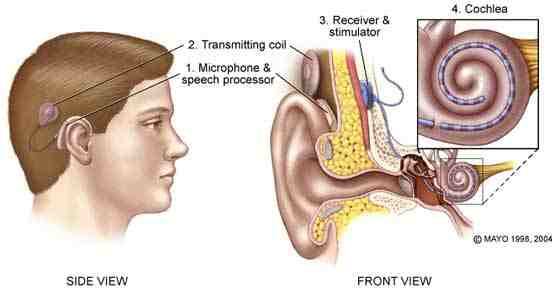
Cochlear Implant Diagram

Image source: Examiner.com

Cochlear implants are devices that may help your child hear. If your child is Deaf or has profound hearing loss, consider talking to his doctor about cochlear implants. Sometimes called “bionic ears,” cochlear implants are not a cure for hearing loss. Whereas a hearing aid amplifies sound, a cochlear implant will bypass the damage in the ear to stimulate the auditory nerve directly. The brain can then interpret the signals sent by the nerve as sound. It can take quite an adjustment to learn to use a cochlear implant, but these little electronic devices can help your child develop speech and language at a rate on target for his age group.


Continue reading

Preventing Acquired Hearing Loss

Hearing Loss
Retro Woman with Fingers in Ears

Image source: Mollypiper.com

Hearing loss isn’t always immediately evident at birth. When the condition arises later, it is called acquired hearing loss. Sometimes, the extent of the hearing loss will worsen over time, in which case it is referred to as progressive. Non-progressive hearing loss does not worsen over time.

Our interview this week with Lori Steed Sortino proves that it is indeed possible for a child to have a happy, fulfilled life with hearing loss. However, it can also be challenging. Amongst other issues, hearing loss can greatly affect the development of speech and language. Not all types of hearing loss can be prevented. But you can reduce the risk of acquired hearing loss by controlling the level of noise in your child’s environment, treating ear infections promptly, and reducing the risk of head injuries. See below for additional causes of acquired hearing loss.

Continue reading

New York Early Intervention Program

State Resources
NYS Map by County

Image source: Health.ny.gov

Early intervention services are designed to assist children with developmental delays or disabilities, from birth to 3 years old. Early intervention is federally mandated, but it is administered through the state governments. In New York, the Bureau of Early Intervention is part of the NYS Department of Health. It administers the New York State Early Intervention Program (EIP). EIP was established in Article 25 of the NY Public Health Law. You can read the regulations in their entirety here.

Continue reading

An Interview with Lori Steed Sortino

Interviews
Lori Steed Sortino

Courtesy: Lori Steed Sortino

This week, Lori Steed Sortino shares her experiences of raising her son, Daniel, who is Deaf. Lori’s blog, Deaf Son, Hearing Mother, emphasizes the positives. Daniel opened Lori’s eyes to a new world of possibilities. Despite the obstacles in his way, Daniel thrived and later became a successful college student. However, the journey wasn’t easy. Lori and her now ex-husband Joe fought to become advocates for their child and faced a great deal of resistance from the school district. While Daniel’s teachers wanted to help him, they were stuck in a system that was unresponsive to Daniel’s needs because of budget constraints. After her difficult experiences, Lori was inspired to work with a parent advocacy group to ensure that the needs of other Deaf children are being met. She emphasizes how critical it is for parents to join a network of support.

Continue reading

How to Improve Articulation

Pronunciation & Lisps Speech Therapy Techniques
Child using Megaphone

Image source: Parents.org.uk

You’ve probably had this experience before: you’re at a playgroup or birthday party with your child, and you’re trying to converse with the other little ones there. But the kid’s speech is difficult to understand, and you have to call his parent over to interpret. Or maybe you have to guess a few times before you can figure out what your own child is saying. It’s perfectly normal for a young child to pronounce “room” as “woom” and “sun” as “thun.” Some children master most or all sounds by five years of age, while others master articulation by the age of eight. If you believe your child might be struggling with articulation, you can request an evaluation by a speech-language pathologist (SLP). If the SLP diagnoses your child with a speech disorder or delay, speech therapy can help improve articulation. You can also use some simple, fun activities at home to encourage proper articulation.

Continue reading